Updated Clinical Review – Improving Functional Vision through Perceptual Learning
After several years of accumulated clinical experience, 2025 marks a significant leap in both the scope and quality of clinical evidence supporting the RevitalVision vision training software, which is based on perceptual learning. During this year, the efficacy and safety of the program were demonstrated in six randomized controlled trials across multiple indications, three of which were published in leading ophthalmology journals. A seventh study evaluated the long-term stability of visual improvements in patients with amblyopia over a five-year follow-up period. This article reviews the key clinical findings from three of these studies.
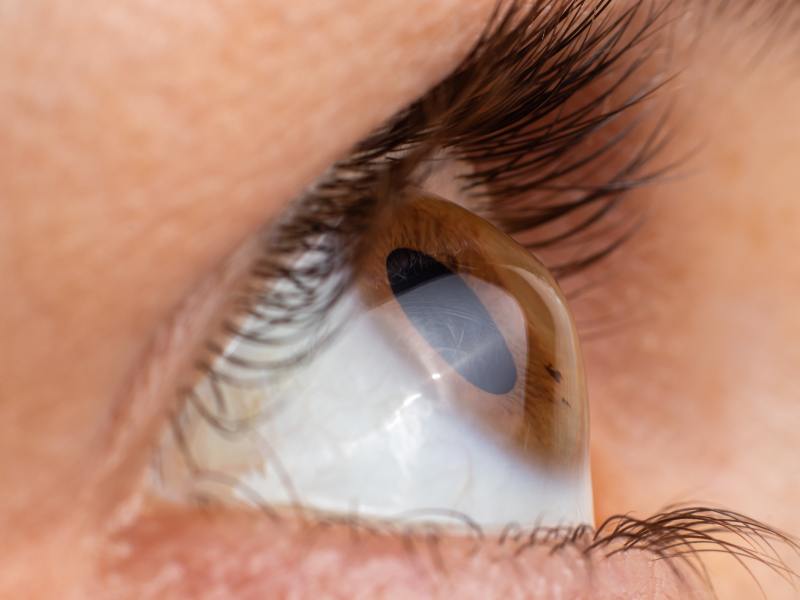
Keratoconus:
Published in January 2025 in the American Journal of Ophthalmology (AJO)
Vision Improvement in Keratoconus Patients Trained with Perceptual Learning: A Randomized Controlled Trial
This double-blind randomized controlled trial evaluated the effectiveness of RevitalVision training in improving best spectacle corrected vision in patients with stable keratoconus who are intolerant to contact lenses. Thirty-five participants were randomized into two groups: a treatment group (n=17) that trained with the software, and a control group (n=18) that used a placebo module within the software. The placebo training also utilized Gabor patch stimuli, but without the adaptive algorithm that personalizes the visual stimulation program.
Participants completed 40 training sessions over a period of three months and were re-evaluated three months after completing treatment. In the treatment group, best-corrected visual acuity improved by an average of 1.7 LogMAR lines, compared to no improvement in the control group (0.02 LogMAR lines), demonstrating statistical significance (P < 0.0006). Additionally, 47.06% (8/17) of patients in the treatment group showed improvement in stereoacuity, compared to 11.11% (2/18) in the control group. Significant improvements in contrast sensitivity were also observed, particularly at spatial frequencies of 3 and 6 cpd.
Infantile Nystagmus:
Published in December 2025 in the British Journal of Ophthalmology (BJO)
Efficacy of Perceptual Learning among Patients with Infantile Nystagmus: A Prospective Single-blind Randomized Controlled Trial
This single-blind randomized controlled trial evaluated the effectiveness of RevitalVision training in improving best corrected vision in patients aged 9–55 with infantile nystagmus. Forty participants were divided into two groups: a treatment group (n=30, mean age 22) and a control group (n=10, mean age 20) that received sham treatment during the study and then crossed over to active treatment afterward.
Participants completed 40 sessions over three months and were re-evaluated six months after completing treatment. In the treatment group, distance best-corrected visual acuity improved by an average of 1.1 LogMAR lines, compared to no improvement in the control group (0.01 LogMAR lines) (P < 0.001). Near visual acuity improved by 2 lines in the treatment group versus 0.01 LogMAR lines in controls (P < 0.001). Stereoacuity improved by 802±730 SOA (p=0.001). Eight of nine patients with suppression at baseline (Worth 4 Dot test) achieved binocular vision following treatment. Contrast sensitivity improved by 292±391% (P < 0.001). Twelve patients (46%) reached a visual threshold sufficient for driving, and 76% reported they would recommend the treatment. During the control crossover treatment phase, an improvement of 1.8 LogMAR lines in distance visual acuity was observed.
Amblyopia:
Published in March 2025 in Latin American Journal of Ophthalmology (LAJO)
Long-term efficacy of perceptual learning therapy in amblyopia: A 5-year follow-up study
This study evaluated the long-term efficacy of RevitalVision in improving best-corrected vision in amblyopic patients aged 8–40. The mean age of the 89 participants was 15.8 years, distributed as follows: 25 patients aged 8–10, 44 aged 11–20, 15 aged 21–30, and 5 aged 31–40. All patients had previously completed occlusion therapy and were included only after reaching a visual plateau for at least six months.
Baseline best-corrected visual acuity was 0.56 ± 0.27 LogMAR. Following treatment, a statistically significant improvement of more than two lines was observed, reaching 0.30 ± 0.24 LogMAR, which remained stable over five years (P < 0.001).
Three additional randomized controlled trials were presented at ASCRS 2025. All received the Best Scientific Paper Award in their session. Two studies in patients with stable keratoconus demonstrated statistically significant improvement in visual acuity and contrast sensitivity, and a third study showed significant improvements in both visual acuity and contrast sensitivity in post-cataract patients implanted with multifocal intraocular lenses, who experienced neuroadaptation difficulties, including reduced visual acuity and low contrast sensitivity.
- Cortical Stimulation in Dissatisfied MF-IOL Patients – RCT Results
- Visual Perceptual Learning in Stable Keratoconus Patients – Preliminary Results
- Patient-Specific Visual Stimulation in Crosslinked Keratoconus
A seventh study evaluated the effectiveness of the software in improving vision in professional soccer players from the Belgian Premier League club Standard Liège. The study demonstrated an average improvement of one line in visual acuity—from 20/20 to 20/15—as well as significant improvements in contrast sensitivity.
In conclusion, the current clinical evidence supports the efficacy and safety of RevitalVision in improving visual function across multiple indications. These findings reinforce the concept that residual neuroplasticity in the adult brain can be effectively harnessed to achieve meaningful improvements in functional vision. Accordingly, it is important to increase awareness and inform patients regarding the availability of this treatment and to consider its role in clinical practice, particularly for patients who have exhausted conventional eye treatment options yet desire further visual improvement.